Map the decision
We identify the recurring choice, accountable operator, constraints and value at stake.
Fable connects the systems you already run to forecast what happens next, compare your options and recommend what to do now.
A worked example with illustrative figures: how the Project Margin Rescue Engine brings five systems together, forecasts a project’s margin and compares the financial impact of each available action.
Five systems describe one project five ways. Fable joins them at the weekly cutoff and strikes the figure that no longer holds.
Matched onProject identity, contract, cost centre and period, with the most authoritative source kept for each figure.
Production models forecast margin at completion as a range, with the likely timing of a breach and what is driving it.
DriversUnpriced variation, labour burn 9% above plan and supplier price drift.
Every permitted action is priced in margin and cash. One is held for capacity, the rest re-rank and the top action gets an owner.
ConstraintProcurement is at capacity this week, so owner time goes to the highest-value permitted actions.
Exposure, expected effect and observed outcome are tracked separately, so finance can recognise what the action changed. Every result is fed back to the engine.
Margin at completion 10.4%, with a 68% chance of finishing below the 12% floor
+$190k to $260k margin from the change order
Submitted by the commercial lead on Friday
Accepted at $228k, two cutoffs later
AttributionFinance recognises the $228k against the original exposure, and the outcome is returned to the engine.
Interactive demo · Commercial Fleet
Explore Fable’s Commercial Fleet workflow. Compare alternatives, inspect the evidence and constraints, and follow the consequences for capacity, contribution and cash.
Explore interactive demo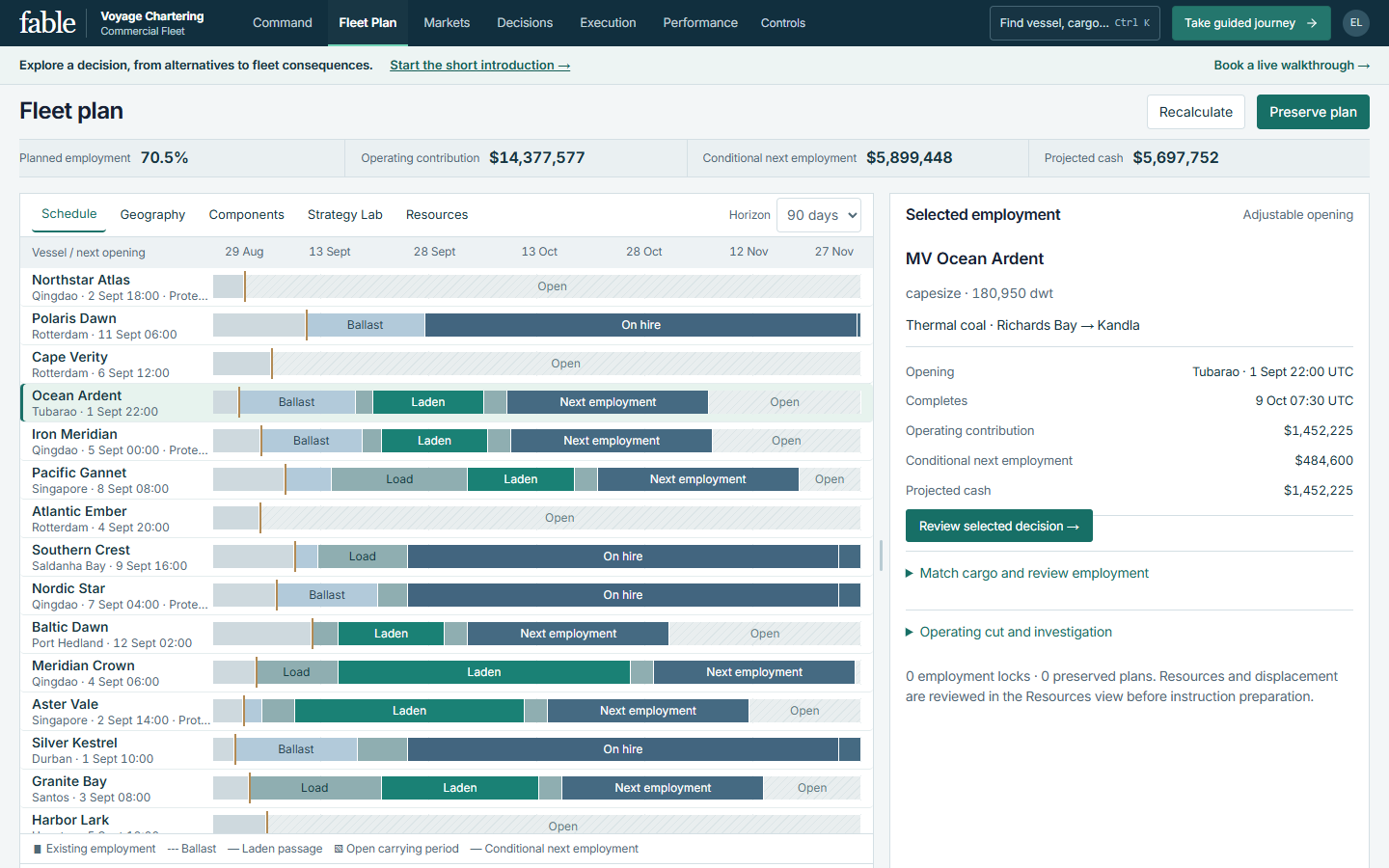
Fable’s Decision Engines address recurring choices across revenue, cash, supply, workforce and operations. This example follows commercial fleet allocation.
46 Decision Engines across ten families, each built around one recurring choice that moves margin, cash or capacity. Two are worked through below. For UK and US upper-mid-market and enterprise operators.
| Rank | Project | Exposure | Recommended action | Expected effect | Status |
|---|---|---|---|---|---|
| 01 | Harbour East, phase 2Margin at completion 10.4% against a 12% floor | $420kMargin | Submit change orderCommercial lead, due Friday | +$190k to $260kMargin | Decision now |
| 02 | Lumen DeliveryBillable WIP held past its milestone | $310kCash | Issue milestone invoiceFinance | $310kCash, 3 weeks earlier | Awaiting approval |
| 03 | Alder ControlsSupplier cost 6% above the purchase order | $95kMargin | Correct supplier costProcurement | +$40k to $70kMargin | HeldProcurement at capacity |
Illustrative data, invented to show how a ledger reads. These are not client results.
| Rank | Range | Exposure | Recommended action | Expected effect | Status |
|---|---|---|---|---|---|
| 01 | Alder Chilled, Central11.2 weeks of cover against a 6 week target | $182kWorking capital | Suspend replenishmentSupply planning | $140kCash released | Decision now |
| 02 | Juniper Pantry, NorthService at 91% against a 97% target | $64kSales at risk | Transfer 48 cases from SouthBranch operations | $52kSales protected | Awaiting approval |
| 03 | Elm Bakery, SouthContribution 4.1% after waste | $38kContribution | Review the rangeCategory | Next cutoffDecided with a fresh forecast | Monitor |
Illustrative data, invented to show how a ledger reads. These are not client results.
Reporting remains useful. Fable adds the forecast, constraint logic and action recommendation required to change the next decision.
| Legacy BI & Dashboards | Fable Decision Engines |
|---|---|
| Shows historical operational data | Forecasts future financial outcomes |
| Requires manual spreadsheet analysis | Recommends specific operational actions |
| Leaves the next action to manual interpretation | Ranks feasible actions across cross-system records |
| Static charts and passive metrics | Machine learning models tied to financial and operational attribution |
Start with the records already running the operation. Fable makes the decision path visible, measurable and usable inside the existing workflow.
We identify the recurring choice, accountable operator, constraints and value at stake.
Fable connects the ERP, CRM, billing, workforce, supply, asset and operational records that inform the choice.
Your team receives a named action with evidence, uncertainty and expected effect inside the existing workflow.
Fable reads from your ERP, CRM, billing, workforce, supply and asset systems and sends approved actions back through their own controls. Nothing is replaced, and each system stays the authority for its own records.
Systems we connect toEnterprise decision software has to work with the systems, controls and commercial model already in place.
Fable works with the systems you already have. Each deployment runs in its own environment, in the region you choose.
In three steps. A paid, fixed-fee opportunity assessment comes first and ends in a projected annual uplift. Implementation and the first year of the licence then cost about 32.5% of that projected uplift, and the licence costs about 25% of it in each year after. Fees are fixed in your contract, and the exact figures depend on the deal.
No. Fable reads from the ERP, CRM, billing, workforce, supply and operational systems you already run, and sends approved actions back to them.
An opportunity assessment and pilot take a few weeks. Full rollout depends on how many systems are involved and the state of their data, so we plan it once the pilot result is in.
We stop or change the scope. Every stage ends with a decision point, and the pilot result against the agreed baseline decides whether we go to production.
No. Any change to your systems needs a named permission and a person’s approval, and duplicate changes are blocked. Every recommendation, approval and action is recorded.
A Fable-managed deployment runs in its own AWS account, in the region you choose. For UK clients that is London by default. We can also deploy into your own infrastructure.
Book a live walkthrough with a Fable representative using the software and decision path that fit your operation.