
Northstar
Workflow Cockpit
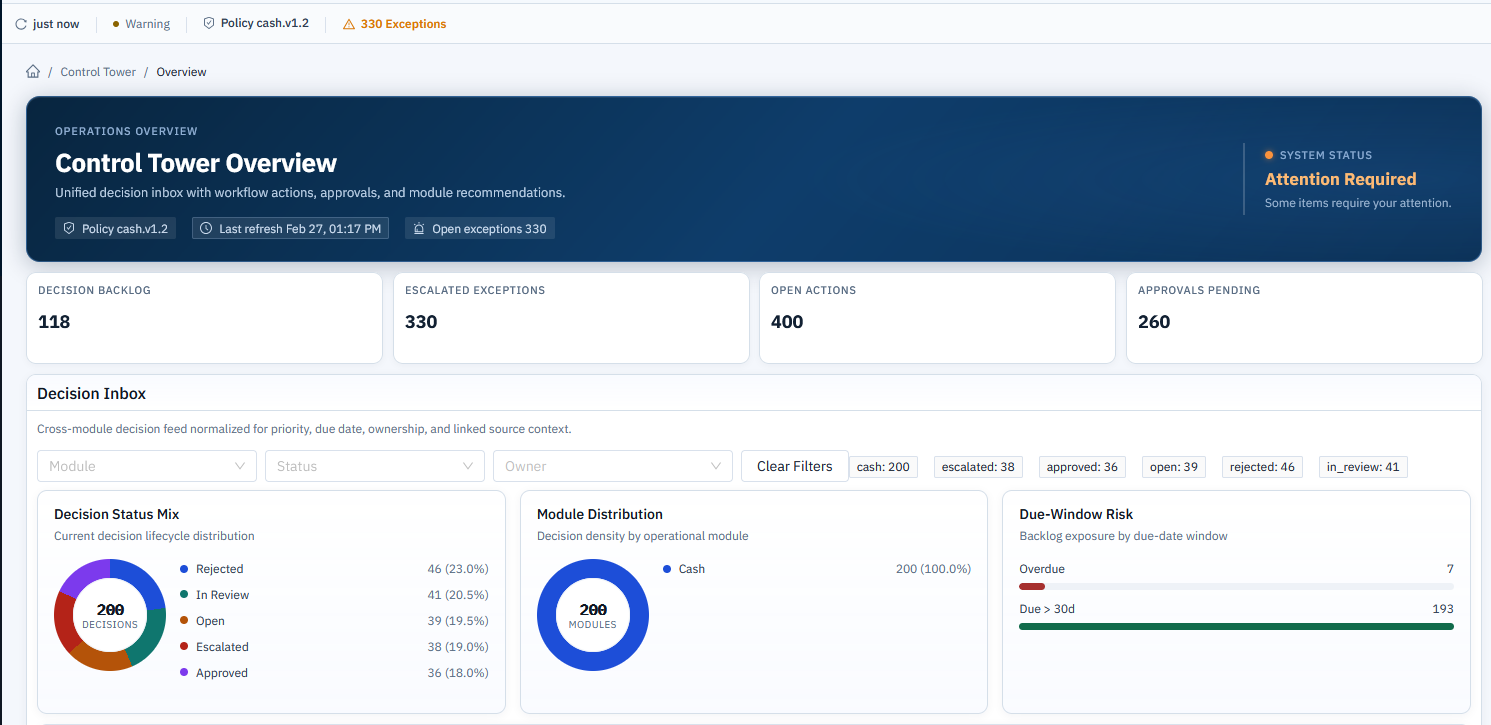
Entity bottleneck decomposition, decision execution, and close-readiness command tape.
Private briefing
This is not a generic capabilities pitch. We pick one decision workflow and pressure-test whether it is controllable.
Platform snapshots
Northstar and CloseControl show how operators move from signal to accountable decision execution.
Northstar
Entity bottleneck decomposition, decision execution, and close-readiness command tape.
CloseControl
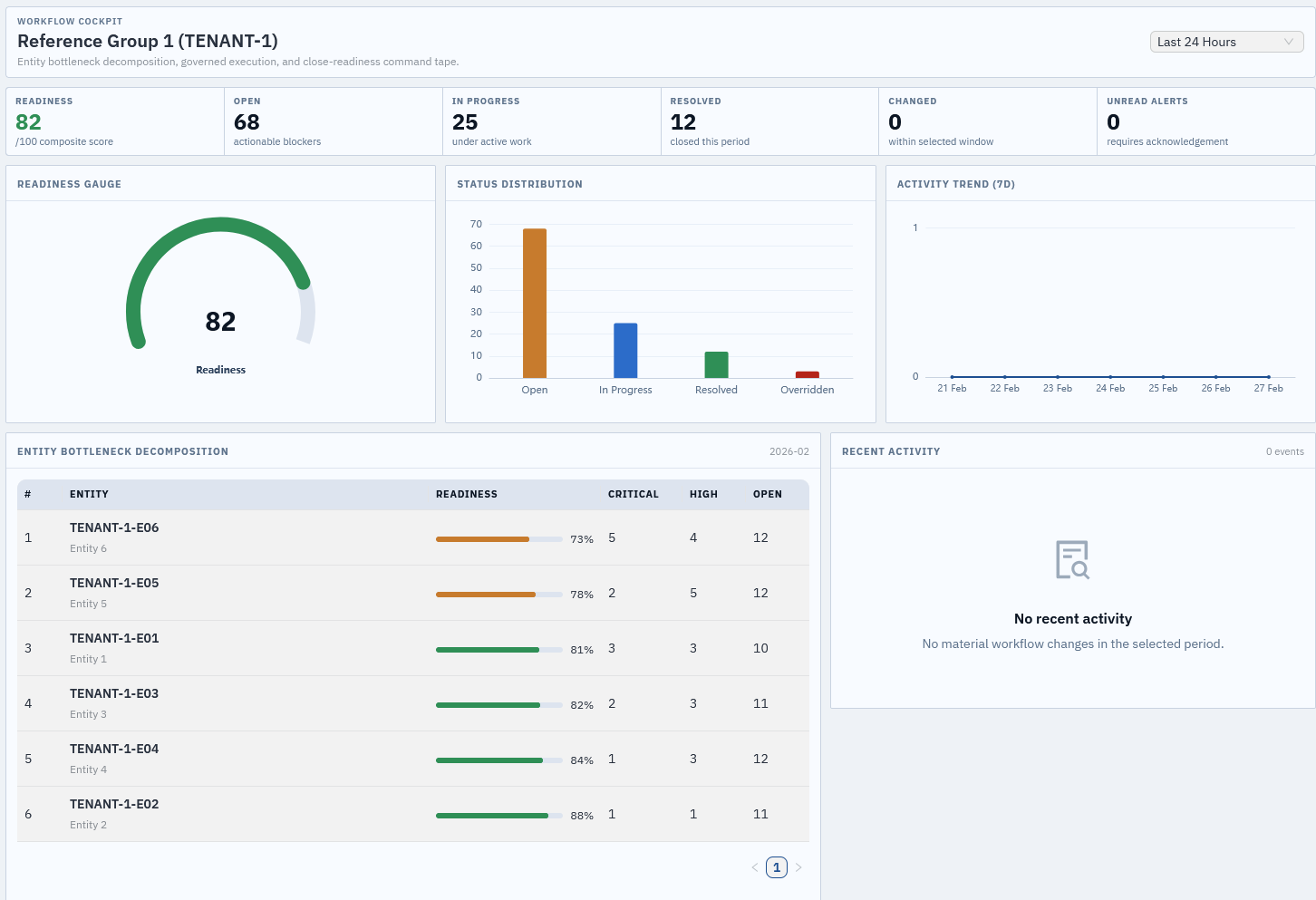
Unified decision inbox with escalations, approvals, due-window risk, and ownership context.
What you'll see in 20 minutes
Who should attend
What we need to prep
Example engines
Each briefing is anchored to one workflow, one owner, and one measurable operating metric.
Inventory policy and service level decisions tied to working capital.
Operating teams balance service level and working capital under demand volatility.
Show how inventory policy, lead time, and supplier reliability move cost, service, and cash outcomes.
Reorder point and safety stock by product class based on service level targets.
Expected fill rate and backorder units tied to demand variability.
Annual holding cost and stockout exposure by class and total.
Working capital tied up and released versus the baseline policy.
Pricing decisions tied to demand response, revenue, and margin.
Price moves often lack clear elasticity, win rate, or capacity impact.
Quantify how price, demand response, and competitive position shift revenue and margin.
Price that maximizes contribution within capacity limits.
Expected demand, revenue, and gross margin at the recommended price.
Share of capacity consumed under the selected price.
Win rate response to competitor price shifts.
Capital allocation scenarios with probability ranges and downside risk.
Capital allocation decisions often rely on deterministic models that hide downside risk.
Quantify outcome distributions and compare downside protection versus upside capture.
Probability range for portfolio outcomes with percentiles.
Value at risk and conditional value at risk at selected confidence levels.
Sharpe ratio and drawdown profile for each scenario.
Probability of meeting hurdle rates and expected downside exposure.
Model drift monitoring and retraining impact on value at risk.
Models decay in production without monitoring, creating value leakage and decision risk.
Show how monitoring cadence, retraining, and automation reduce drift exposure.
Expected value at risk from decision errors per month.
Time to detect drift and restore baseline performance.
Score derived from accuracy stability and automation coverage.
Estimated value preserved by improving monitoring and automation.
Briefings align scope and ownership, then the QOA validates measurable upside and delivery feasibility.