Project margin and cash
Reeve
Which active projects need intervention now to protect margin, cash timing or delivery economics?
Billable work past its milestone, days
- Project, sized by contract value
- Ranked for action
- After the recommended action
Forecast margin at completion
- 01
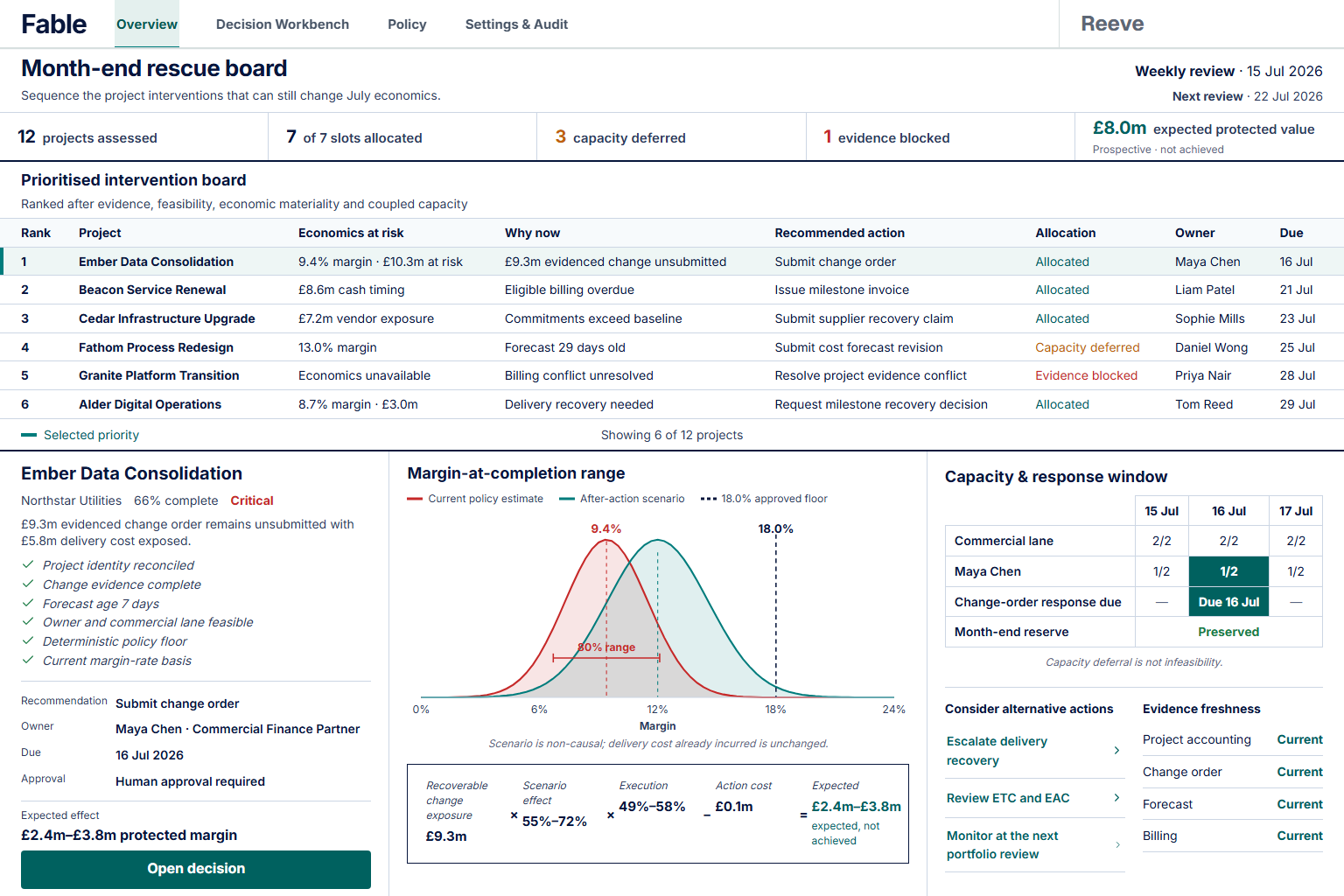
Harbour East, phase 2Decision now
Margin at completion 10.4% against a 12% floor
- Exposure
- $420kMargin
- Expected effect
- +$190k to $260kMargin
Submit change orderCommercial lead, due Friday
- 02
Lumen DeliveryAwaiting approval
Billable WIP held past its milestone
- Exposure
- $310kCash
- Expected effect
- $310kCash, 3 weeks earlier
Issue milestone invoiceFinance
- 03
Alder ControlsHeld
Supplier cost 6% above the purchase order
- Exposure
- $95kMargin
- Expected effect
- +$40k to $70kMargin
Correct supplier costProcurement. Procurement at capacity
- Exposure ranked
- $825k
- Margin recoverable
- $230k to $330k
- Cash brought forward
- $310k
Illustrative figures. Not client results.
Why current systems fall short.
- A single project’s budget, actuals, time, WIP, billing, forecast and contract sit in different systems.
- Point forecasts hide the range and timing of possible margin outcomes.
- Variance reports flag a problem but do not choose an intervention the team has capacity to deliver.
- The project most at risk is not always the one where an intervention recovers the most value.
The records it reads.
Each system remains the authority for its own data. The engine reconciles identities, units and dates at each decision cutoff and flags any conflict.
- 01ERP and project accounting
- 02PSA and timekeeping
- 03Billing, AR and WIP
- 04Procurement and supplier cost
- 05PMO, contract and forecast history
What each part of the engine does.
Forecasts are settled before the options are scored. Permissions and hard constraints always take priority.
| Component | Responsibility | Effect on the decision |
|---|---|---|
| Machine learning | Forecast remaining cost, the distribution of margin at completion, the timing and type of a breach, and the probability that an action will be completed. | Sets the forecast used to compare the options |
| Rules and constraints | Match records, enforce authority, currency, lifecycle and contract rules, and provide the fallback when a model cannot be used. | Removes actions that are not allowed or not feasible |
| Optimisation | Choose which permitted project actions receive limited PMO and owner capacity. | Chooses the set of actions to take |
Actions it recommends.
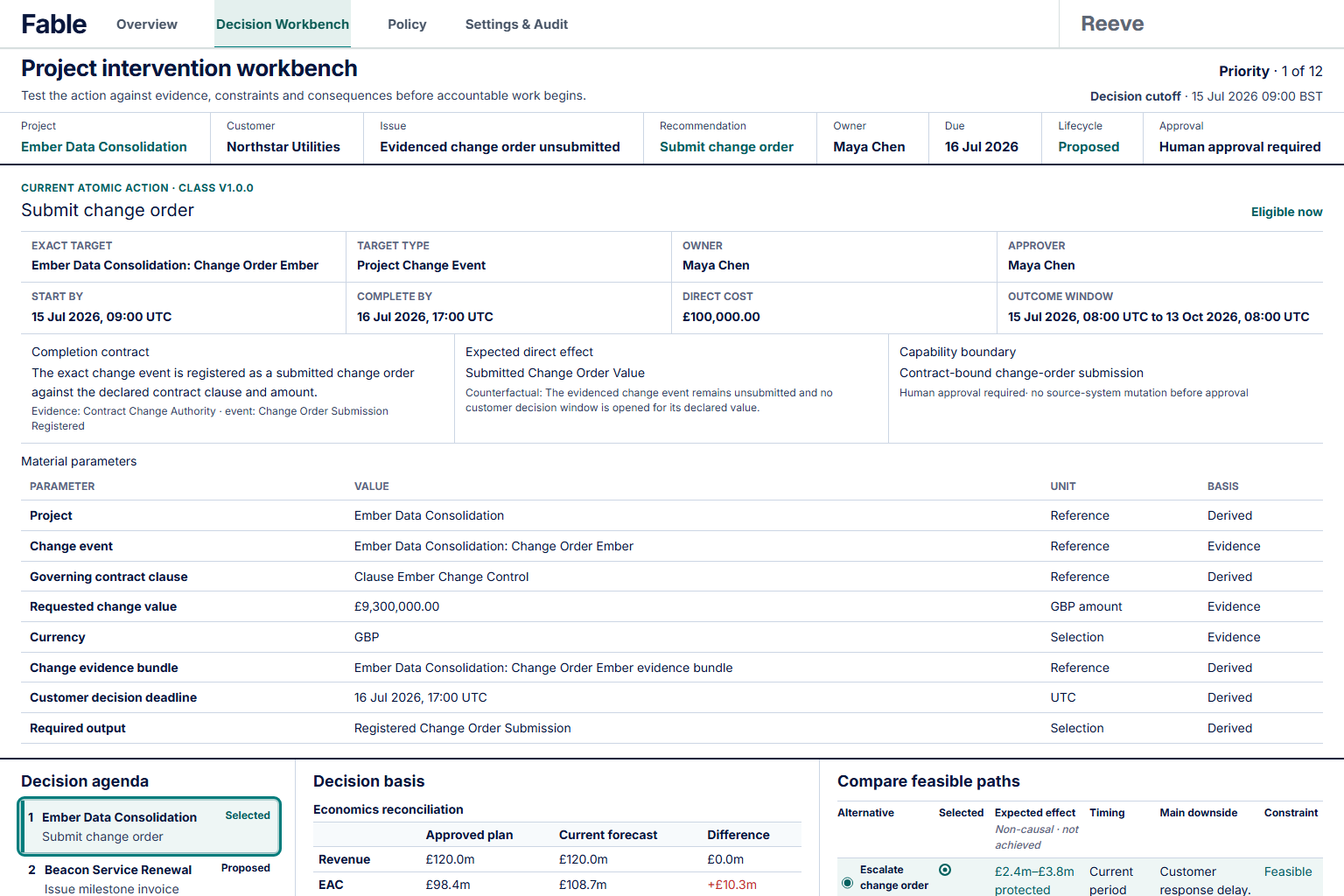
Each recommendation names the action, its target, owner and deadline, the constraints it respects and the evidence that confirms completion.
- 01Revise the estimate to complete for a named project
- 02Issue an eligible milestone invoice against its billing event
- 03Submit a change order backed by the contract evidence
- 04Request a correction to a named supplier cost
- 05Hold an intervention, with a set trigger to review it again
How value is measured
Tracks the original exposure, the portion the action can affect, the expected effect, completion, observed outcome, verification and finance recognition separately for each project and time window.
How it runs in your operation.
The engine runs in a dedicated AWS account or your own infrastructure, connects to your systems and uses models calibrated on your records.
- Scope
- Every active project, at each weekly cutoff
- Connected systems
- ERP, project accounting, timekeeping, billing and procurement
- Approval
- Every action is approved before it changes a source system
Shown with sample data.
What the opportunity assessment checks.
Can the available project history improve the weekly choice of intervention, and can finance verify the result?
What we need to see
- Projects identifiable across forecast, actuals, time, WIP and billing
- Project outcomes and forecast versions as they stood at each past cutoff
- A named project controls owner with authority to intervene
- A margin, cash or write-off outcome that finance can verify
When we would advise stopping
- Project records cannot be reliably reconciled across systems
- No named owner has the authority to act on the margin loss
- Finance has no way to verify the outcome
Assess this decision in your operation.
The opportunity assessment looks at your historical records, the actions available, who has authority to act and the value at stake, before a pilot begins.
Book a live walkthrough